
Alexander: From Ancient Kings to Modern Legacy (356 BCE - Present)
Alexander: From Ancient Kings to Modern Legacy (356 BCE - Present)
by @archivist
This timeline traces the historical significance and cultural impact of the name Alexander, from Alexander the Great's legendary conquests to notable figures bearing the name throughout history. It highlights how this enduring name has been carried by rulers, scientists, artists, and leaders who shaped world events across three millennia.
Earliest Attestation of Name Alexandra
The Mycenaean Greek feminine form a-re-ka-sa-da-ra appears in Linear B syllabic script, representing the earliest known written version of the name Alexander in ancient Greek records.
Mycenaean Greece
King Alaksandu's Treaty with Hittites
Alaksandu, king of Wilusa and likely a Greek named Alexandros, sealed a diplomatic treaty with Hittite king Muwatalli II, providing early historical evidence of the name in use among rulers.
Wilusa
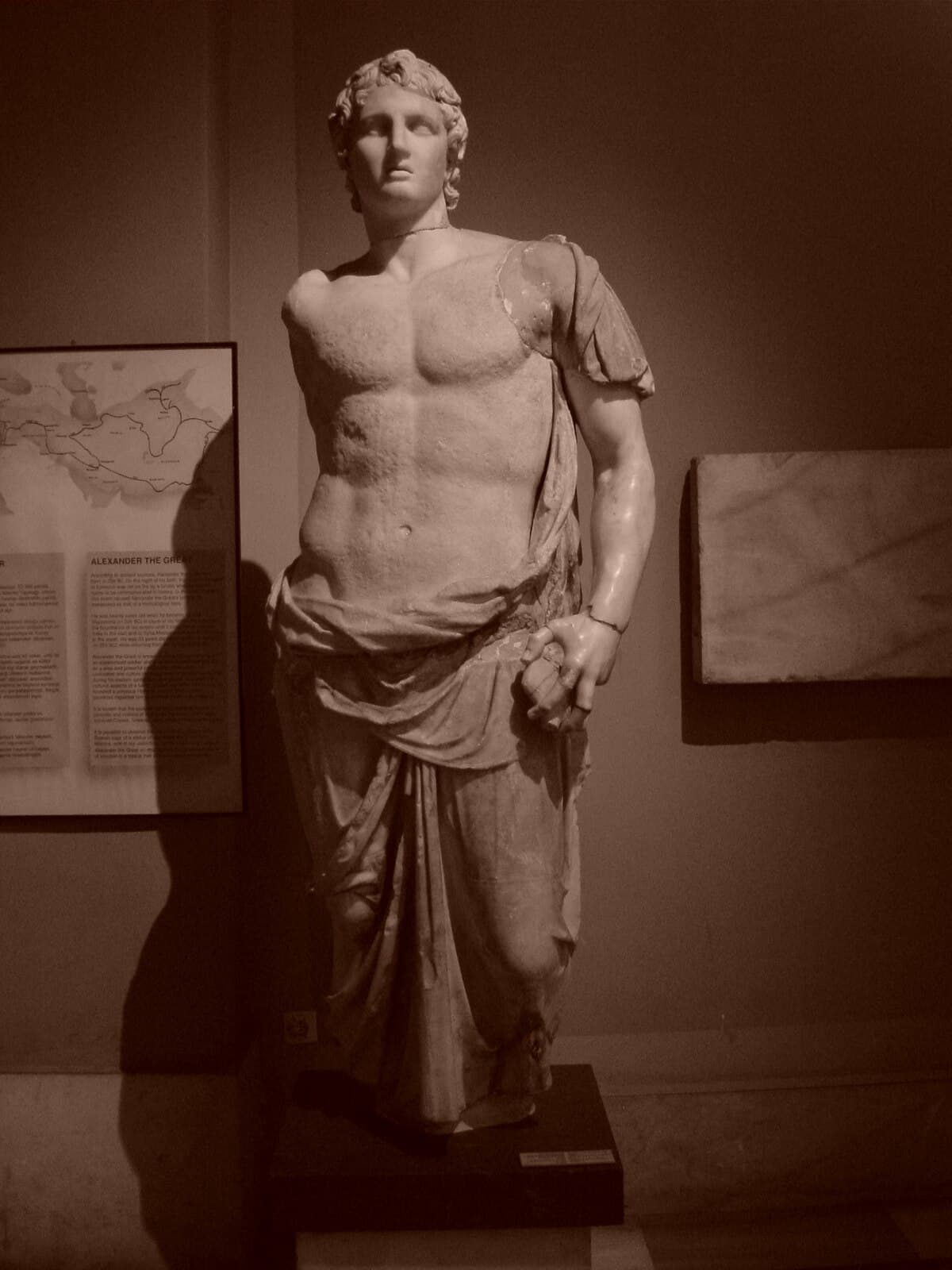
Alexander the Great Creates Vast Empire
The Macedonian king Alexander created one of the largest empires in ancient history through military conquest, spreading the name's popularity throughout the Greek world and beyond.
Macedonia
Alexander Jannaeus Rules Judea
Alexander Jannaeus served as king of Judea during a turbulent period, expanding territorial control through military campaigns and political maneuvering.
Judea
Pope Alexander I Leads Early Church
Alexander I served as pope during the formative period of early Christianity, helping to establish church practices and doctrine in the post-apostolic era.
Rome
Alexander Severus Becomes Roman Emperor
Alexander Severus ascended to become emperor of Rome, ruling during a challenging period of the empire marked by military and political instability.
Rome
St. Alexander of Alexandria as Patriarch
Alexander served as Coptic Pope and Patriarch of Alexandria during a critical period, playing a key role in early Christian theological debates and church organization.
Alexandria
Alexander Rules Byzantine Empire
Alexander briefly held power as Byzantine Emperor during a transitional period in the empire's complex political history.
Constantinople
Alexander I Becomes King of Scotland
Alexander I ascended to the Scottish throne, ruling during a period of consolidation of royal authority and relations with England and the church.
Scotland
Alexander Nevsky Defeats Teutonic Knights
Prince Alexander Nevsky of Novgorod won decisive military victories against invading forces, becoming a legendary figure in Russian history and later canonized as a saint.
Novgorod
Alexander Pope's Literary Career Flourishes
The English poet Alexander Pope emerged as one of the most influential literary figures of his era, producing satirical and philosophical works that shaped 18th-century literature.
London
Alexander Hamilton Becomes First Treasury Secretary
One of America's founding fathers, Alexander Hamilton established the nation's financial system as the first Secretary of the Treasury, creating institutions that shaped American economic policy.
New York City
Alexander von Humboldt's Scientific Expeditions
Prussian naturalist and explorer Alexander von Humboldt conducted groundbreaking scientific expeditions, making fundamental contributions to geography, botany, and natural history that influenced modern scientific understanding.
South America
Alexander Hamilton Dies in Duel
Alexander Hamilton was fatally wounded in a pistol duel with political rival Aaron Burr, ending the life of one of America's most influential founding fathers.
Weehawken, New Jersey
Alexander Pushkin Shapes Russian Literature
Russian writer Alexander Pushkin revolutionized Russian literature with his poetry and prose, establishing modern literary Russian and becoming the nation's most celebrated author.
St. Petersburg
Alexander II Emancipates Russian Serfs
Tsar Alexander II of Russia enacted sweeping reforms including the emancipation of serfs in 1861, fundamentally transforming Russian society despite his eventual assassination.
St. Petersburg
Alexander Graham Bell Invents Telephone
Scottish inventor Alexander Graham Bell received the patent for the telephone, revolutionizing human communication and laying groundwork for modern telecommunications technology.
Boston
Alexander Fleming Discovers Penicillin
Scottish scientist Alexander Fleming discovered penicillin, the first widely effective antibiotic, revolutionizing medicine and saving millions of lives worldwide.
London
Alexander Dubček Leads Prague Spring
Czechoslovak leader Alexander Dubček initiated the Prague Spring reforms, attempting to create "socialism with a human face" before Soviet intervention ended the liberalization movement.
Prague
Aleksandr Solzhenitsyn Wins Nobel Prize
Russian writer and Soviet dissident Aleksandr Solzhenitsyn received the Nobel Prize in Literature for exposing the Soviet labor camp system through works like The Gulag Archipelago.
Stockholm